
There are films that grab your attention through big performances, elaborate set-pieces or dramatic storytelling, and then there are films like 100 Sunset, which draw you into a world that feels wonderfully authentic because of the people and community at its heart.
For her feature directorial debut, Tibetan-Canadian filmmaker Kunsang Kyirong takes us into Toronto’s Parkdale neighbourhood, offering an intimate look at the Tibetan community and the lives of two young women trying to find their place in a world where friendship, trust and survival are never quite as straightforward as they seem.
What makes this film particularly special is the way it has been made. Rather than simply using a community as the backdrop for a fictional story, Kyirong has worked closely with Toronto’s local Tibetan community, bringing non-professional actors into the production and filming in real homes, apartments and neighbourhood locations. The result is a film that feels lived-in rather than staged, giving audiences a genuine glimpse into a community that rarely receives this kind of attention on screen.
The Story
At the centre of the story is Kunsel (Tenzin Kunsel), a young, introverted Tibetan woman living in Toronto’s Parkdale neighbourhood. Shy and withdrawn, she spends much of her time observing the people around her, developing an unusual habit of spying on her neighbours and occasionally helping herself to their belongings.
Kunsel’s curiosity about the lives of others becomes more pronounced when she steals a camcorder, allowing her to record the everyday activities of the people living around her. It is through this quiet observation that she becomes particularly interested in Passang (Sonam Choekyi), a young woman who has recently moved into the apartment complex with her older husband.
The two women gradually develop an unexpected friendship, and Kunsel begins to find a connection that has been missing from her otherwise isolated existence.
However, Passang has problems of her own. Trapped in an unfulfilling marriage, she confides in Kunsel about her desire to escape and start a new life. As their relationship develops, Kunsel becomes increasingly involved in Passang’s plans, drawing both women into a situation involving deception, missing money and a breach of trust within their close-knit community.
What begins as a seemingly simple friendship gradually becomes something more complicated, forcing Kunsel to confront questions about loyalty, morality and the consequences of her actions.

A Community at the Heart of the Film
One of the biggest strengths of 100 Sunset is undoubtedly its setting and the way Kyirong uses the local Tibetan community as an integral part of the storytelling.
Parkdale isn’t simply a location chosen because it looks interesting on camera. It is a living, breathing community, and the film captures the relationships, routines and everyday interactions that make this environment feel so distinctive.
There is a fascinating contrast between the closeness of the community and the individual lives of the people living within it. Everyone seems to know everyone else’s business, yet that doesn’t necessarily mean people understand one another or know what is happening behind closed doors.
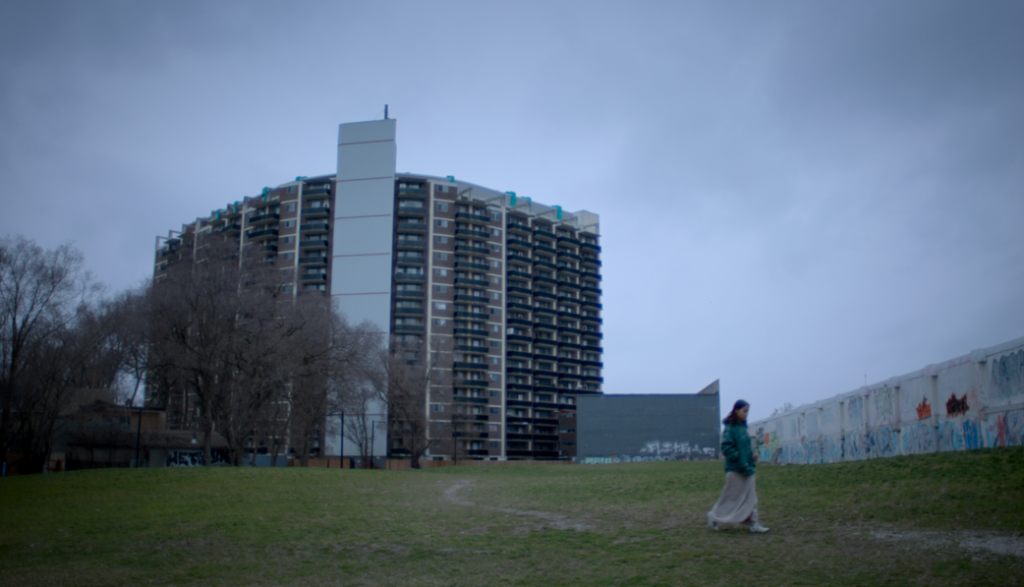
The apartment complex becomes almost a character in its own right, with balconies, corridors and shared spaces providing opportunities for Kunsel to observe those around her. It also creates an interesting visual dynamic, allowing Kyirong to explore the idea of watching others while remaining emotionally disconnected herself.
I particularly appreciated the decision to make the film alongside the community it portrays. The production used non-professional actors, many of whom were making their first appearance on screen, and real locations within Parkdale. Kyirong spent considerable time getting to know her two leads before filming, building relationships and allowing the characters and performances to develop naturally.
This approach gives the film an authenticity that would have been difficult to recreate through conventional casting and studio environments. The conversations, interactions and little details of everyday life feel natural, and there is a real sense that we are being invited into a world rather than simply watching actors recreate one.
It is also refreshing to see a film that gives a Tibetan-Canadian community such an important place in the story, presenting its people and experiences without relying on familiar cinematic stereotypes.

Performances
With a cast largely made up of non-professional actors, there is a natural quality to the performances that works particularly well for the film’s understated approach.
Tenzin Kunsel is excellent as the central character. Kunsel is not your conventional lead, and much of her performance comes through her expressions, reactions and the way she quietly observes everything happening around her. She is an introverted young woman who seems more comfortable watching other people than becoming involved in their lives, and the performance captures that sense of isolation particularly well.
Sonam Choekyi brings a different energy as Passang. She is more outgoing and appears to have a clearer idea of what she wants from life, although her own circumstances are far from straightforward. The relationship between the two women is the emotional foundation of the film, and watching their friendship develop provides some of its most engaging moments.
Tsering Bawa also contributes as Geysar, Kunsel’s uncle, helping to establish the wider family and community environment surrounding her.
What I enjoyed most about the performances is that nothing feels overly theatrical. These are characters who feel like ordinary people dealing with complicated circumstances, and that naturalistic approach is exactly what the film needs.
Direction and Cinematography
For a first feature, Kunsang Kyirong demonstrates a confident understanding of atmosphere and visual storytelling.
Rather than rushing through the narrative, she allows scenes to develop at their own pace. There is a quiet observational quality to the filmmaking, which mirrors Kunsel’s own fascination with watching the people around her.
The camcorder is an interesting storytelling device, representing both Kunsel’s curiosity and her inability to connect with people in a more conventional way. She can observe their lives, but understanding them is another matter entirely.
The cinematography by Nikolay Michaylov makes excellent use of the apartment complex and its surroundings, with carefully composed shots creating a sense of depth and separation between characters. There is also an understated beauty to the everyday locations, helping to give the film its distinctive atmosphere.
The pacing is deliberately measured, and viewers looking for a conventional thriller with constant twists and revelations may find themselves wanting a little more urgency. However, I think the film benefits from taking its time and allowing us to become familiar with the characters and their environment.
Final Thoughts
100 Sunset is a quietly absorbing directorial debut from Kunsang Kyirong, and one that deserves attention for both its storytelling and the way it has been brought to the screen.
The friendship between Kunsel and Passang provides an engaging central narrative, while the themes of trust, isolation, identity and survival give the film something more substantial to explore.
For me, the real achievement is the involvement of the Tibetan community. By working with non-professional actors and using real locations, Kyirong has created something that feels genuinely connected to the people and neighbourhood being portrayed. It gives the film an intimacy that is difficult to manufacture, and makes it all the more rewarding to watch.
There are moments when the narrative could perhaps have offered a little more explanation, and its deliberately slow pace won’t appeal to everyone. But I would much rather see a filmmaker take this kind of approach and give us something personal than simply follow a familiar formula.
For a feature debut, Kyirong has delivered a thoughtful and distinctive piece of filmmaking that shines a light on a community and experiences we don’t often get to see represented on screen.
100 Sunset is a film about finding connection in an environment where everybody seems to know everybody, yet understanding another person’s life can be much harder than it appears.
A lovely piece of independent cinema and a very promising start for Kunsang Kyirong.
In cinemas 20th November
Eastern Film Fans Rating: ★★★★☆ (4/5)
